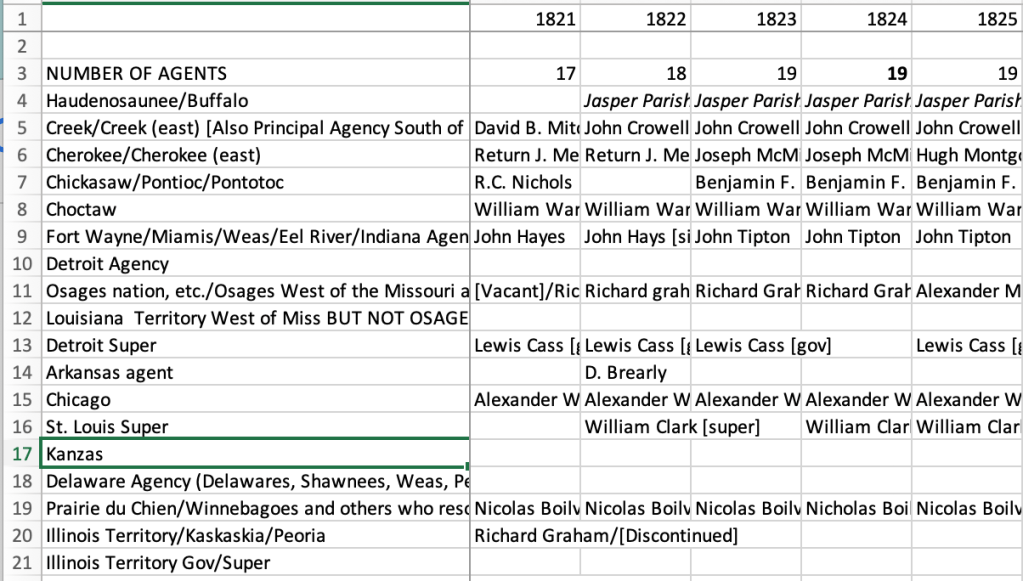
One of the ways I am hoping to enrich historians’ understandings of early US-Indigenous relations (“Indian affairs”) is by providing some quantitative data about the corps of federal Indian agents from the Washington through Van Buren administrations. This has required learning a new skill: counting!
Starting in college, and then much more fully in graduate school, I learned that, one upon a time, in the 1970s and ‘80s, a school of thought known as the “New Social History” was ascendant among early American historians. These new social historians rejected as mere anecdote much of previous historical scholarship, producing relentlessly analytic, narrative-phobic monographs and articles heavily dependent upon the quantitative tools at the disposal of data-loving social scientists like political scientists, sociologists, and economists (history being a discipline poised somewhat uneasily between the humanities and the social sciences). With admirable fortitude, new social historians of early America used seemingly dry archives, such as baptismal records rotting in the basements of venerable New England churches, and now-primitive computers, to advance our understanding of the lives of the many, many human beings in Colonial, Revolutionary, and Early National America who did not produce livelier written records like diaries and letters, or whose documents once existed but were (tragically!) discarded as the uninteresting scribbling of unimportant people.
Learning about this vein of scholarship, I was doubly grateful: grateful that it exited and grateful that I did not have to do it. Beginning in the 1990s, qualitative methods had regained their pre-NSH supremacy, this time altered by a new, cultural anthropology-influenced emphasis on societies’ systems of meaning-making. In our own century, best of all, it became generally accepted that scholarly early Americanists in good standing could produce, in addition to analysis-heavy monographs, works of history that relied upon, of all things, storytelling. Sometimes even quite vivid narrative, conveyed through prose that a reader might enjoy on the sentence level rather than just respect as a medium for the transmission of information.
I still love the turn to ethnography and narrative among early Americanists. Even in my first monograph, necessarily an analysis-heavy work, I am happily making use of (I hope!) engaging narratives about individual Indian agents and their various Indigenous and white interlocutors. At the same time, I began to realize, when writing the book proposal that would begin my project’s journey from dissertation to academic book, that I could not only improve my own work, but give something of lasting value that my present and future colleagues could put to their own uses, if I supplemented my qualitative analyses of, and narratives about, early Indian agents with a modest bit of quantitative social science.
I began asking a few questions about the corps of Indian agents that could be addressed systematically: How did the number of presidentially-appointed agents change over time? How did the passage of time alter the percentages of Indian agents who chose to marry into Indigenous kinship networks, or had already developed such relationships before entering office? To what extent did the transitions from the Federalists to the Jeffersonians to the early Jacksonian Democrats affect the degree to which Indian agents were qualified for their jobs, as opposed to winning their appointments entirely for partisan reasons?
Before I could answer any of those questions, though, I had to simply find the names of the Indian agents each year from 1789 to 1845. I say “simply” because this work was conceptually basic. As a matter of legwork, it took some doing. For some years, there existed US government “Blue Books” listing every employee of the federal government (imagine a federal government small enough for that to be possible!), but those only began in 1816 and even then covered just every other year. Fortunately, there were a variety of texts I could use to cobble together the information, including the American State Papers series, the presidential papers collections, the indispensable Territorial Papers of the United States series, various one-off publications by congressional committees investigating the government’s Indian affairs operations, and more.
I can now proudly say I know which agent represented the government to which Indigenous nation, or which set thereof, for each year covered by my book. Phew!
A preliminary presentation of this basic quantitative information appeared in my Summer 2026 Diplomatic History article, “Creating the ‘Great American Father’: Indigenous Sovereignty, Republican Monarchy, and the International Consequences of the American Revolution.” (The article is available for free online to all readers through November 2026; after that, if you lack access through a university library, I would be happy to share a PDF copy upon request). In that article, I share a graph breaking down the Indian agent numbers by presidential administration, giving the count for each presidential election year.
I am now working on the more complex and interesting questions I can address quantitatively: changes over time in intermarriage rates and the rates of purely partisan appointments. Here, I am using some of the printed primary sources mentioned above, as well as the manuscript primary sources that inform my monograph’s qualitative sections (still the overwhelming majority of the book), while also relying—quite gratefully—upon the secondary literature. While there is not yet a book like mine, treating early Indian agents as an office or diplomatic corps, there are, fortunately, a number of valuable studies in which individual agents appear as biographical subjects or major supporting “characters.” Most of these are the product of authors focused on state and local history. I am so grateful to everyone whose work I am drawing upon here; all authors consulted will, of course, receive proper citation in the book.
After the book is released, I plan to share my findings another way: by publishing the entire mass of the data itself in the wonderful forum that enables early Americanists to do so: the Magazine of Early American Data Sets. I feel like I am barely scratching the surface here (a cliché, but one I feel obliged to dust off) and am excited to see what others are able to find out in the years to come.

